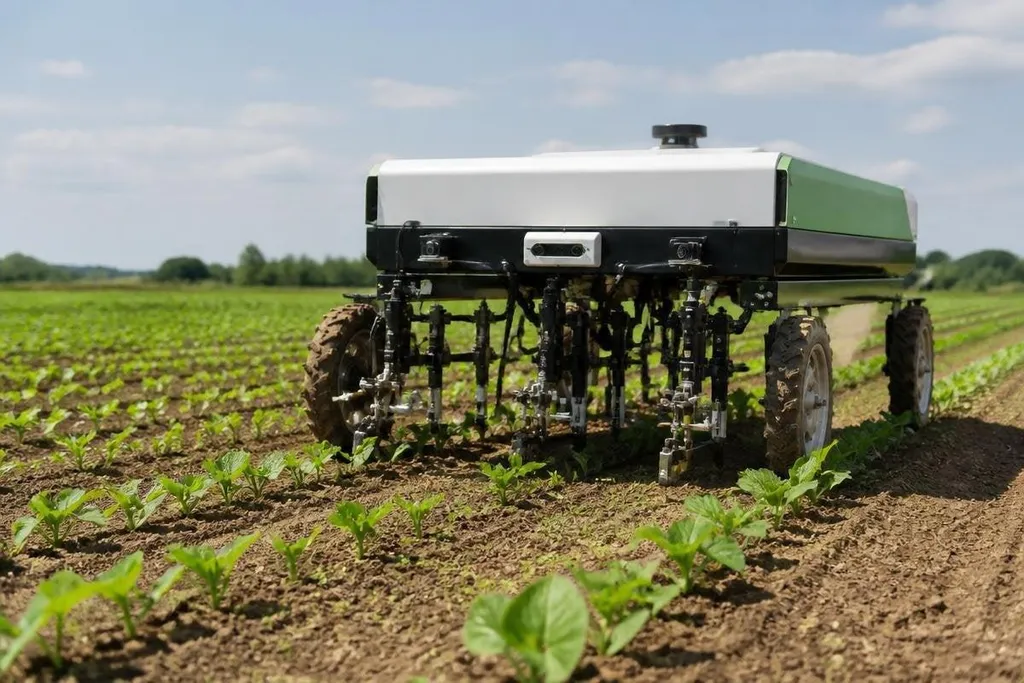
A weeding robot can remove unwanted plants close to crops, giving growers another way to manage weeds without treating a whole field. The idea depends on three things working together: plant detection, careful movement, and a tool that acts only where needed.
- Robots can inspect plants row by row instead of treating a full field.
- Mechanical tools may remove some weeds without herbicide.
- Results depend on crop spacing, soil, weather, and detection accuracy.
How the robot finds weeds
The robot needs to tell a crop from a weed before it acts. A camera can collect images as the robot moves, while software checks plant shape, position, color, or the gap between plants. The exact method depends on the crop and the field.
That distinction matters because a weed may grow only a few centimeters from a crop stem. A broad spray can cover both plants. A robot that works close to the row can direct its tool toward the weed and leave the crop untouched.
Plant detection still has limits. Dust, shadows, wet leaves, damaged crops, and dense growth can make the scene harder to read. A machine that misses weeds will leave work behind, while one that mistakes crops for weeds can cause direct losses.
Mechanical removal and targeted spray
Some robots use a blade, hoe, finger, or other mechanical tool to disturb the soil around a crop. The tool cuts or pulls weeds as the robot passes, so the machine can work without applying herbicide to that patch.
Mechanical removal works best when the robot can keep a steady path and reach weeds at the right stage of growth. Large weeds may need more force, while small weeds can be harder to see. Soil that is too wet can also affect how the tool moves and how well it removes the plant.
Other systems may use a small spray area rather than covering the full row. That approach still uses chemicals, but it can limit treatment to spots where the robot identifies weeds. The reduction comes from treating less ground, not from removing chemical use altogether.
What changes for a grower
A robot could change the timing and location of field work. Instead of sending a worker or tractor across every row, the grower may use the machine on a defined area where weeds are present.
The practical benefit depends on how much area the robot can cover and how often it needs a person to check it. That makes operating conditions as important as the robot itself.
Crop spacing must leave enough room for the machine, row edges need clear boundaries, and the field must be safe for the robot to cross. A system made for wide, even rows may struggle in a field with irregular planting.
A grower comparing weed-control machines can read farm robotics reports from Robot24.com for field trial details, machine limits, and the work left to people. Those facts put lower chemical use beside labor, repair, and safety costs before the next section tests what the robot can prove on its own.
What the robot cannot prove on its own
A lower spray volume does not by itself show a lower total environmental cost. The full result also depends on battery charging, repairs, transport to the field, and how many passes the robot needs. Those figures must be measured for a real crop and growing season.
The robot may also shift work rather than remove it. Someone still needs to set routes, check plant damage, clear blocked tools, clean sensors, and respond when the machine stops. If those tasks take too long, the chemical saving may not cover the added work and equipment cost.
No evidence pack was supplied for this article, so there are no claims here about a specific model, farm, chemical reduction, price, or field result. Those details should come from a named test or deployment before you make a purchase decision.
A practical buying check
Use this checklist before comparing machines:
- Crop fit: Confirm the robot was built for your crop spacing and row width.
- Detection proof: Ask for uncut field footage showing crops and weeds in similar light.
- Tool choice: Check whether it cuts, pulls, disturbs soil, or sprays a small area.
- Human work: Count setup, route checks, cleaning, repairs, and recovery after stops.
- Measured result: Ask for chemical use before and after, along with crop damage and weed control.
The next useful test is a full field record: chemical volume, robot hours, labor time, crop damage, and weed control from the same growing season. Until a machine can show those numbers, treat reduced chemical use as a possible result, not a promised one.